

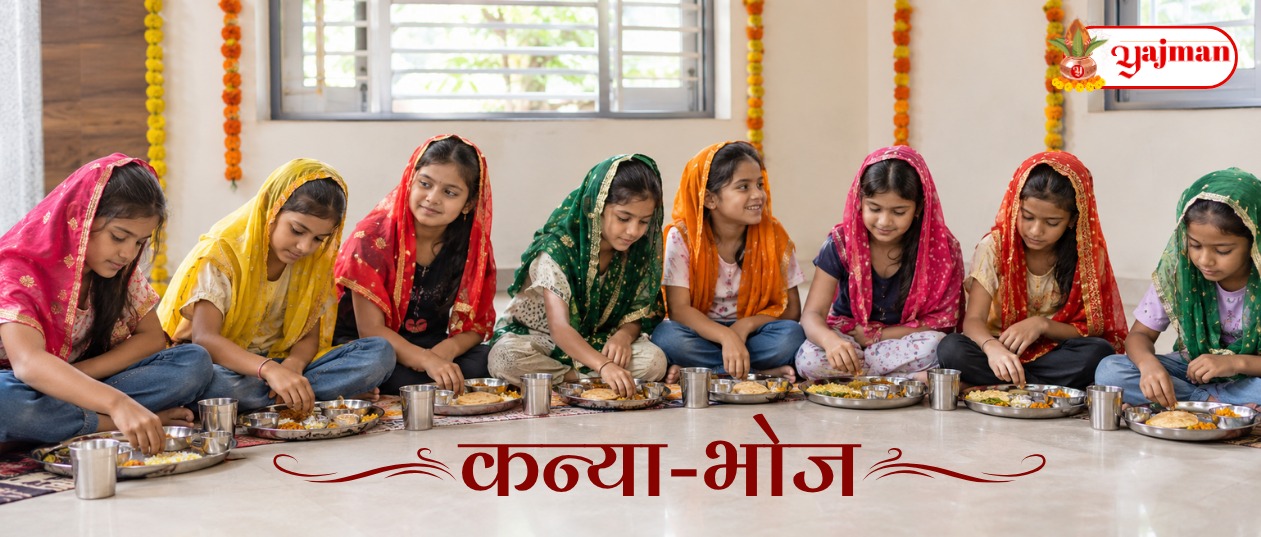
Kanya Bhojan is the Navratri tradition of inviting young girls home, honouring them as living forms of Goddess Durga, and serving them a pure meal with gifts. It matters because many devotees believe Navratri worship is complete only when the Devi is honoured in the girl child. In 2026, Durga Ashtami and Maha Navami both fall on Monday 19 October in India, which makes it the main day for Kanya Bhojan in most homes.
Shardiya Navratri 2026 began on Sunday 11 October, and its most sacred days are now very close. This guide explains the meaning of Kanya Bhojan, why girls are worshipped during Navratri, the correct date, the full vidhi, the traditional menu, suitable gifts and common mistakes. It also shows how families who are far from home can still take part with devotion.
What Is Kanya Bhojan in Navratri?
Kanya Bhojan, also known as Kanya Pujan, Kanjak Pujan or Kumari Puja, is the ritual of worshipping and feeding young girls during Navratri. The girls are welcomed as embodiments of the Divine Mother. Their feet are washed, a tilak is applied, a sattvic meal is served with love, and gifts are offered before they leave with blessings.
The spiritual meaning is simple and deep. Navratri teaches devotees to see the Devi in every form of life. Kanya Bhojan turns that teaching into action. Instead of bowing only before an idol or a picture, the devotee bows before a living child, and in that moment worship and everyday life meet.
Why Are Young Girls Worshipped as Goddess Durga During Navratri?
Young girls are worshipped during Navratri because Hindu scriptures see Shakti, the Divine Feminine, in all women, and the girl child is regarded as a symbol of purity and innocence. The Devi Mahatmya, which is part of the Markandeya Puran, praises the Goddess as the power present in all beings, while the Devi Bhagavata Purana describes Kumari worship as part of Navaratra.
The Devi Mahatmya, also known as Durga Saptashati, tells in its second chapter how the combined radiance of all the gods took form as the Goddess, who then defeated the demon Mahishasura. The story presents Shakti as a living power and not a distant idea.
In the Narayani Stuti, found in the eleventh chapter of the same text, the gods praise the Goddess and say that all branches of knowledge are her aspects and that all women in the world are her forms. Devotees have read this passage for centuries as a call to respect women and girls as expressions of the Divine.
The great sage Vyasa shares this timeless truth:
"सर्वस्वरूपिणी देवी कुमारीरूपमाश्रिता। तस्मात् सम्पूजयेत् कन्यां सर्वकामफलप्रदाम्॥"
Meaning: "The Goddess, who lives in every part of the universe, takes a special form in young girls. Therefore, one should honor and serve the Kumari with full devotion, as she fulfills good wishes, brings happiness, and grants inner peace."
Our texts say that while big rituals, grand offerings, and hours of chanting have their place, feeding a child with a clean, loving heart brings the quickest and purest blessings.
Importance and Benefits of Kanya Bhojan
Many Devi traditions teach that Navratri fasting and sadhana remain incomplete without honouring the girl child. This is a widely held devotional belief, and families across North India follow it every year, usually on Ashtami or Navami.
Devotees traditionally associate Kanya Bhojan with the blessings below. These are matters of faith and not guaranteed outcomes, and they are best held as an expression of hope along with sincere effort in daily life.
Removal of obstacles. Many devotees believe the Goddess clears delays in work and eases the weight of past karma when she is honoured with a full heart.
Prosperity and abundance. Feeding the girls is seen as pleasing Maa Lakshmi, who is linked with wealth, stability and growth in the home.
Family peace and protection. A house that welcomes children warmly and offers them food is believed to gain a calm and positive atmosphere.
Blessings of children. Devotees pray for the joy of parenthood and for the wellbeing of their own children when they perform this ritual with faith.
Victory and success. Kanya Pujan is also considered a spiritual support for success in career, studies and competitive goals.
Fulfilment of sankalp. Because Navratri is observed with a vow, closing it with Kanya Bhojan is seen as bringing that sankalp to a proper end.
The Devi Bhagavata Purana also speaks of different fruits for worshipping girls of different ages, which is explained further in the age section below.
When Is Kanya Bhojan in Navratri 2026? Ashtami or Navami
In India, Kanya Bhojan 2026 falls on Monday 19 October, because Durga Ashtami and Maha Navami are observed on the same day according to Drik Panchang. Some regional calendars mark Ashtami on 18 October and Navami on 20 October. Kanya Pujan is best done in the morning, before midday, while the tithi is in effect.
Shardiya Navratri 2026 began with Ghatasthapana on Sunday 11 October and ends with Vijayadashami on Tuesday 20 October. This year the Ashtami tithi ends early on 19 October and Navami continues through the rest of that day, which is why most North Indian panchangs place both observances together on Monday 19 October. Families in the United States, Canada and the United Kingdom may find Ashtami on Sunday 18 October and Navami on Monday 19 October because of the time difference.
The Devi Bhagavata tradition suggests worshipping Kumaris on all nine days. In practice, most households choose one day, either Ashtami or Navami, according to their family custom, known as kul parampara. If your family has always done it on Ashtami, continue that way. If you follow Navami, 19 October suits you as well.
Tithi timings differ from city to city, so please confirm the exact timing with your local panchang or family priest. We have not listed a clock muhurat here because it changes by location. If you cannot be at home on the day, you can still take part by booking the Navratri Special Kanya Bhojan Seva on Yajman App, where the number of Kanyas is chosen as per your wish.
Kanya Pujan Vidhi: How to Perform Kanya Bhojan Step by Step
The vidhi can vary slightly from region to region, and your family priest can guide you. The steps below follow the order commonly practised in homes.
First, prepare the home and the heart. Clean the puja space, keep the kitchen pure, and cook the food fresh and without onion or garlic. Many families keep their fast until the girls have eaten.
Second, invite the girls a day earlier. Speak to their parents politely and fix a comfortable time, so that no child is kept waiting.
Third, welcome them with respect. Seat the girls on a clean mat or low seats. Wash their feet gently with clean water and dry them with a soft cloth. Apply roli or kumkum on the forehead with a few grains of rice, and tie a sacred red thread on the wrist.
Fourth, offer a short prayer. Light a diya, offer flowers, and recite a Durga mantra or simply pray to the Devi in your own words. What matters most is sincerity.
Fifth, serve the prasad with your own hands. Many families first offer a small portion to the Devi and then serve the girls.
Sixth, give gifts and dakshina, touch the feet of the girls with respect and ask for their blessings. After they leave, the family usually breaks the fast with the remaining prasad.
How Many Kanyas Should You Invite and What Age Is Right?
Nine girls is the most common number, representing the nine forms of Durga, but reference works on the Puranas note that there is no strict rule on the count. Girls from about two to ten years of age are considered suitable. Many families also seat one small boy beside the girls as Langur or Batuk Bhairav, which is a regional custom and not a scriptural requirement.
The Devi Bhagavata Purana, Third Skandha, names the Kumaris by age. A two year old is Kumarika, three is Trimurti, four is Kalyani, five is Rohini, six is Kali, seven is Chandika, eight is Shambhavi, nine is Durga and ten is Subhadra. The text advises against worshipping children below two years. It also describes the blessings linked to each form, for example relief from hardship for Kumarika, good health for Rohini and prosperity for Chandika.
The Importance of the Little Boy (Batuk Bhairav)
Along with the young girls, it is customary to invite at least one young boy, often called the Langur or Batuk.
In our traditions, Lord Shiva takes the form of a young boy named Batuk Bhairav to accompany, protect, and stand beside Maa Durga. By feeding and honoring a young boy alongside the girls, the puja feels balanced and complete, ensuring that the peaceful energy of the ritual stays guarded and safe.
Traditional Kanya Bhojan Menu
Halwa, puri and kala chana is the classic Kanya Bhojan menu across North India. This is a customary tradition and not a scriptural instruction. You may add kheer, seasonal fruits or a simple sweet. Keep the meal sattvic, fresh and mild, and remember that children enjoy food that is not too spicy. Ask the parents about any allergies before serving.
Suitable Kanya Bhojan Gifts
Thoughtful gifts make the day memorable. Popular choices include a chunri or dupatta, bangles, hair accessories, colouring books, stationery, story books, fruits and a small cash dakshina. Pick gifts that are useful and suitable for the age of each child.
Common Mistakes to Avoid During Kanya Bhojan
The first mistake is treating the ritual as a formality. A rushed or distracted Kanya Pujan loses its warmth, so keep phones away and give the girls your full attention.
The second is poor planning. Late invitations, heavy or very spicy food and long waiting times can tire the children and their parents.
The third is pressure. Never force a child to finish everything on the plate or to pose for photographs. Always take the permission of the parents before clicking pictures.
The fourth is ignoring the tithi or the family custom. Check the panchang and follow the tradition of your household.
The last mistake is forgetting the spirit of the ritual. The girl is not a guest to be impressed. She is the Devi to be honoured.
The Social and Emotional Value of Honouring Girls
Beyond rituals and beliefs, Kanya Bhojan carries a quiet social message. For one day, a child is placed at the centre of the home, her feet are touched, and her blessings are sought. For many girls, this is an early memory of being respected, and for adults it is a reminder that respect for women must continue after Navratri ends.
The ritual also brings neighbourhoods together. Families invite children from the street, the society or the extended family, and the day turns into a small celebration of community. Parents who see their daughters honoured often feel a deeper pride, and children learn that kindness, food and gratitude belong together.
What If You Cannot Arrange Kanya Bhojan at Home?
Many devotees want to perform Kanya Bhojan but face real difficulties. Some live abroad, some are away from home for work or study, some are caring for elderly parents or recovering from illness, and some simply cannot find nine girls in time on a busy festival morning.
Devotional tradition has always allowed worship to be done with a sankalp, where the devotee takes a vow in their name and a trained pandit carries out the ritual with proper vidhi. This is how many families perform pujas at distant temples, and the same idea applies to Kanya Bhojan.
How Yajman App Makes Kanya Bhojan Possible
Yajman App brings authentic Vedic rituals to devotees through verified pandits, and this Navratri it offers two Kanya Bhojan services. Both can be booked through the Yajman App or the website.
The first is the Navratri Special Kanya Bhojan Seva. Here the devotee can select the sankalp as per their wish, whether it is one Kanya or more, and book for the date that suits them. It is a thoughtful option for families who want to offer Kanya Bhojan in a way that fits their devotion and their situation.
The second is the Navratri Special Nav Kanya Bhojan Seva, a dedicated service for feeding nine Kanyas directly, reflecting the nine forms of Goddess Durga that are worshipped during Navratri.
The process is simple. Choose the seva, enter your name for the sankalp, select the date and pay the dakshina. On your behalf, an experienced Pandit Ji performs the traditional foot cleansing and Shastriya worship of the Kanyas, offers pure sattvic bhojan, and presents gifts and dakshina with respect. You then receive the puja video on your WhatsApp number, so that you can witness the seva wherever you are.
It is the same sincere offering, made possible for the devotee in Indore, in another Indian city, or on the other side of the world.
Frequently Asked Questions About Kanya Bhojan in Navratri
Why is Kanya Bhojan done in Navratri?
Kanya Bhojan is done because girls are honoured as living forms of Goddess Durga. Devotional tradition holds that Navratri worship is completed by serving the Devi in the girl child. The Devi Mahatmya and the Devi Bhagavata Purana support the idea of Shakti in all women.
On which day should Kanya Bhojan be done in 2026?
In India, Durga Ashtami and Maha Navami both fall on Monday 19 October 2026 according to Drik Panchang, so most families will perform it that day. Follow your family custom and confirm the tithi timing with your local panchang.
How many girls should be fed during Kanya Bhojan?
Nine girls is the common practice, matching the nine forms of Durga. There is no strict rule on the number, and girls from about two to ten years of age are considered suitable. A small boy as Langur is a regional custom.
What should be served in Kanya Bhojan?
Halwa, puri and kala chana is the traditional menu across North India. Kheer, fruits and sweets are good additions. Keep the food sattvic, without onion and garlic, and mild enough for children to enjoy.
What gifts are given in Kanya Bhojan?
Common gifts include a chunri, bangles, hair accessories, stationery, books, fruits and a small cash dakshina. Choose age appropriate and useful gifts, and offer them with respect after the meal.
Can Kanya Bhojan be done by someone who lives far away?
Yes. Devotees who cannot be present can take a sankalp and have the ritual performed on their behalf. On Yajman App, you can book the Kanya Bhojan Seva or the Nav Kanya Bhojan Seva through the app or website.
What is the difference between Kanya Pujan and Kanya Bhojan?
Kanya Pujan refers to the worship of the girls with foot washing, tilak and prayer, while Kanya Bhojan refers to feeding them. In practice both happen together on the same day, and the names are used interchangeably.
Honour the Devi in the Girl Child This Navratri
Kanya Bhojan is one of the gentlest and most meaningful rituals of Navratri. It asks for little more than a sincere heart, a clean kitchen and respect for a child. With Ashtami and Navami arriving on 19 October 2026, there is still time to plan.
If you wish to offer Kanya Bhojan from wherever you are, book the Navratri Special Kanya Bhojan Seva or the dedicated Nav Kanya Bhojan Seva on Yajman App or at yajmanapp.com, and let your devotion reach the Devi.